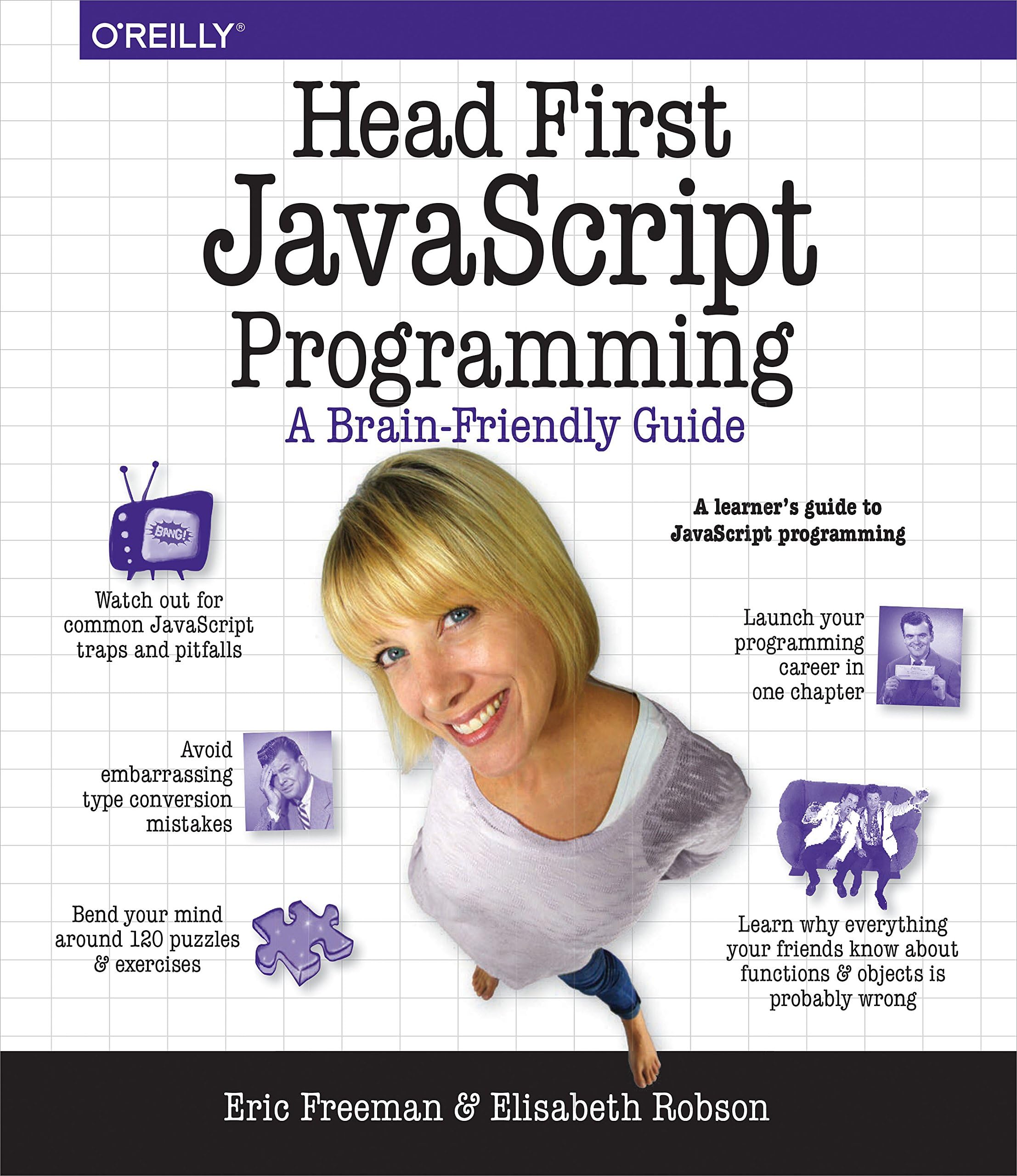
Head First JavaScript Programming: A Brain-Friendly Guide
Product ID: 3646002
Desertcart purchases this item on your behalf and handles shipping, customs, and support to Gibraltar.
What will you learn from this book? This brain-friendly guide teaches you everything from JavaScript language fundamentals to advanced topics, including objects, functions, and the browser�?�¢??s document object model. You won�?�¢??t just be reading�?�¢??you�?�¢??ll be playing games, solving puzzles, pondering mysteries, and interacting with JavaScript in ways you never imagined. And you�?�¢??ll write real code, lots of it, so you can start building your own web applications. Prepare to open your mind as you learn (and nail) key topics including: The inner details of JavaScript How JavaScript works with the browser The secrets of JavaScript types Using arrays The power of functions How to work with objects Making use of prototypes Understanding closures Writing and testing applications What�?�¢??s so special about this book? We think your time is too valuable to waste struggling with new concepts. Using the latest research in cognitive science and learning theory to craft a multi-sensory learning experience, Head First JavaScript Programming uses a visually rich format designed for the way your brain works, not a text-heavy approach that puts you to sleep. This book replaces Head First JavaScript, which is now out of print. Review: Very good for experienced programmers too (in other languages). - This book keeps you engaged, and keep you moving - even if you don't have a good reading practice of Technical books. I have read about closures in Java 8 and groovy articles, but I completely understood it only from this book. The coining of the word 'free variables' - variables which are neither local nor global, but declared in the enclosing functions is very good. The definition and explanation that - functions returned from other functions which has also free variables attached to it (in its environment), and those free variables are live variables and not a copy is a very good explanation. For experienced programmers in other languages (say 5 to 9, which I am ) , you will find this book interesting only if you write answers to the problems and have a pencil with you all the time. Else, it will be a book containing very basic programming constructs which you might know it already. but, if you write the answers, you may find that you made some mistakes and you will wonder why For experienced javascript programmers, I am not sure whether you will find it more exiciting, but certain chapters on - Objects, Prototypes, event handling will help you to keep your basics strong. Few instances are 1. In a chapter - "they build a War Ship Game", the whole code will be divided into Controller, Model and View. This is well explained and would let you think that, even a small peice of code should not hang on the JS file, but go inside a object as a method or a property. The control should start and end like this : EventHandlers triggered by windows.onload --> Controller -> Model ->View 2. The transition from each topic was very good. They described about variables and functions (global and local), and then they explained why it has to be inside a Object Literal. and later described why they have to be inside a Contructor (Object object rather than Object Literal), and then they explain why all the commonly used functions and variables should be inside a Prototype, and finally, they explained Prototypical inheritance. 3. All the hanging functions (alert, prompt etc.,,) and objects (console) are properties of window object. Also, all the user defined global variables and functions would be attached to the window object 4. Also, by default "this" would be pointing to window object. Whenever you call a function on a Object Literal or object, the "this" will point to that object instance(that is why you refer the variable with this inside a member method). also, whenever you can a constructor with new, an object will be created, and "this" will point to that object inside the constructor. 5. Also, when a instance is returned by the constuctor, a Constructor.prototype object (an empty object) will be also be attached the object instance. this will help you to understand prototypical inheritance a lot better in the later chapter. 6. Math is an Javascript supplied object. Date, RegExp are constructors. That is why you would always write Math.random(), and new Date(), new RegExp(/^\d{3}-?\d{4}/). This book is NOT for javasript programmers who are very good in their basics. I cant comment on this a lot, because I just now started to work on my first javascript project, but aspiring to be a good one by end of this year. For aspiring programmers (who were never programmers), I think, this is a very good book to start your career. Review: Highly recommended as first learning resource for JavaScript programming - For the last two years, I have been struggling with learning to code. This was due to a mix of having a busy schedule that hasn't always been conducive to learning code in my spare time, along with having cobbled together a number of tutorials online and never coming out of any of them feeling like I truly understood the concepts. I had ignored this book for a while now despite seeing it recommended now and again. It seemed juvenile in its approach. Instead I attempted to jump straight into more advanced books, always having to stop reading them after a few chapters because concepts weren't sinking in. Finally, after putting down code for half a year and realizing I'd forgotten nearly everything, I decided to pick up this book. I honestly wish I had purchased this two years ago. This book does a wonderful job at explaining concepts as simple as how to assign a variable and as advanced as closures and object prototypes. The conversational approach to this book means that when you're first starting out, you don't have to waste time attempting to interpret an extremely technical explanation of concepts, as I found with this book I understood almost straight away in most cases. The book's difficulty level does ramp up around the time the Battleship game is built in chapter 8. (By the way, this chapter does a great job of introducing MVCs without actually having you use one that's pre-built.) Therefore I would even recommend this book to intermediate learners if they have had trouble truly understanding advanced object construction, closures, how to use prototypes - essentially everything chapter 8 onward. The exercises in this book also give good practice to solidify what you're learning. What this book doesn't cover, or only lightly touches upon: (1) Writing complex algorithms. The book's focus is on getting a good understanding of concepts, not on working through challenges that require much algorithmic thinking. (Unless you want to build Battleship on your own in chapter 8.) A supplemental resource would be necessary for this. (2) Any JavaScript library or framework, including jQuery. There are 2 pages that touch upon jQuery at the very end of the book. This is a good thing. Too many resources online have you learning jQuery without understanding vanilla JavaScript. (3) Making API calls. (4) Promises (5) Anything else that is seen in chapter 14 ("Top 10 Topics We Didn't Cover"). Overall I strongly recommend this book. Like any resource, it should not be the only thing you use to teach yourself to code. However, it is a great starting resource for beginners as well as a supplemental resource for anyone who has the basics down but needs to clarify some of the more complex concepts later in the book.








| Best Sellers Rank | #1,002,367 in Books ( See Top 100 in Books ) #182 in JavaScript Programming (Books) #1,406 in Software Development (Books) #1,619 in Computer Programming Languages |
| Customer Reviews | 4.6 out of 5 stars 967 Reviews |
P**N
Very good for experienced programmers too (in other languages).
This book keeps you engaged, and keep you moving - even if you don't have a good reading practice of Technical books. I have read about closures in Java 8 and groovy articles, but I completely understood it only from this book. The coining of the word 'free variables' - variables which are neither local nor global, but declared in the enclosing functions is very good. The definition and explanation that - functions returned from other functions which has also free variables attached to it (in its environment), and those free variables are live variables and not a copy is a very good explanation. For experienced programmers in other languages (say 5 to 9, which I am ) , you will find this book interesting only if you write answers to the problems and have a pencil with you all the time. Else, it will be a book containing very basic programming constructs which you might know it already. but, if you write the answers, you may find that you made some mistakes and you will wonder why For experienced javascript programmers, I am not sure whether you will find it more exiciting, but certain chapters on - Objects, Prototypes, event handling will help you to keep your basics strong. Few instances are 1. In a chapter - "they build a War Ship Game", the whole code will be divided into Controller, Model and View. This is well explained and would let you think that, even a small peice of code should not hang on the JS file, but go inside a object as a method or a property. The control should start and end like this : EventHandlers triggered by windows.onload --> Controller -> Model ->View 2. The transition from each topic was very good. They described about variables and functions (global and local), and then they explained why it has to be inside a Object Literal. and later described why they have to be inside a Contructor (Object object rather than Object Literal), and then they explain why all the commonly used functions and variables should be inside a Prototype, and finally, they explained Prototypical inheritance. 3. All the hanging functions (alert, prompt etc.,,) and objects (console) are properties of window object. Also, all the user defined global variables and functions would be attached to the window object 4. Also, by default "this" would be pointing to window object. Whenever you call a function on a Object Literal or object, the "this" will point to that object instance(that is why you refer the variable with this inside a member method). also, whenever you can a constructor with new, an object will be created, and "this" will point to that object inside the constructor. 5. Also, when a instance is returned by the constuctor, a Constructor.prototype object (an empty object) will be also be attached the object instance. this will help you to understand prototypical inheritance a lot better in the later chapter. 6. Math is an Javascript supplied object. Date, RegExp are constructors. That is why you would always write Math.random(), and new Date(), new RegExp(/^\d{3}-?\d{4}/). This book is NOT for javasript programmers who are very good in their basics. I cant comment on this a lot, because I just now started to work on my first javascript project, but aspiring to be a good one by end of this year. For aspiring programmers (who were never programmers), I think, this is a very good book to start your career.
A**R
Highly recommended as first learning resource for JavaScript programming
For the last two years, I have been struggling with learning to code. This was due to a mix of having a busy schedule that hasn't always been conducive to learning code in my spare time, along with having cobbled together a number of tutorials online and never coming out of any of them feeling like I truly understood the concepts. I had ignored this book for a while now despite seeing it recommended now and again. It seemed juvenile in its approach. Instead I attempted to jump straight into more advanced books, always having to stop reading them after a few chapters because concepts weren't sinking in. Finally, after putting down code for half a year and realizing I'd forgotten nearly everything, I decided to pick up this book. I honestly wish I had purchased this two years ago. This book does a wonderful job at explaining concepts as simple as how to assign a variable and as advanced as closures and object prototypes. The conversational approach to this book means that when you're first starting out, you don't have to waste time attempting to interpret an extremely technical explanation of concepts, as I found with this book I understood almost straight away in most cases. The book's difficulty level does ramp up around the time the Battleship game is built in chapter 8. (By the way, this chapter does a great job of introducing MVCs without actually having you use one that's pre-built.) Therefore I would even recommend this book to intermediate learners if they have had trouble truly understanding advanced object construction, closures, how to use prototypes - essentially everything chapter 8 onward. The exercises in this book also give good practice to solidify what you're learning. What this book doesn't cover, or only lightly touches upon: (1) Writing complex algorithms. The book's focus is on getting a good understanding of concepts, not on working through challenges that require much algorithmic thinking. (Unless you want to build Battleship on your own in chapter 8.) A supplemental resource would be necessary for this. (2) Any JavaScript library or framework, including jQuery. There are 2 pages that touch upon jQuery at the very end of the book. This is a good thing. Too many resources online have you learning jQuery without understanding vanilla JavaScript. (3) Making API calls. (4) Promises (5) Anything else that is seen in chapter 14 ("Top 10 Topics We Didn't Cover"). Overall I strongly recommend this book. Like any resource, it should not be the only thing you use to teach yourself to code. However, it is a great starting resource for beginners as well as a supplemental resource for anyone who has the basics down but needs to clarify some of the more complex concepts later in the book.
K**.
Enlightening
Is it strange to say that a Javascript book has a great ending? Well, this one did. I'm not one of the people who was asked to do a review. I just bought a hardcopy and actually read every word on every page for my own use - just a regular web developer looking to deepen my understanding. My skill level: I've been studying Javascript for a couple of years and have used it a lot at my new job in the last 6 months. Sometimes I inherit projects that have pre-existing Javascript that is sometimes pretty complex. We also use some frameworks and libraries like jQuery, Express, nodeJS, and AngularJS. So, I got this book to understand all those things better. About the Book: The book itself is steady and clear with a variety of projects and written in a friendly tone. It starts from zero, so if you know nothing, you're in the right place. If, like me, you've been working in it and have wondered what some of the parts do at a fundamental level but haven't had a chance to get to the bottom of it, this book will probably cover it. Even though it covers the basic stuff, it also gets into advanced topics. In fact, the last three chapters are worth the cost of the book alone. The chapter on prototypal inheritance upped my game in one evening. No kidding. My Experience with the Book: It's over 600 pages but flows pretty quickly considering the topic. If like me, you've been working with Javascript, you might find the first 400 pages or so to be a refresher and zoom through. After about pg. 400, I started running into more bits of info and concepts that really clarified some things. That's where I really started getting grateful that they'd done all this hard work. As I went through this book, I was also going through the 12 hour series "Crockford on Javascript" at the same time. He gets pretty in depth in some of it and on a spooky number of occasions I'd just learned a concept the night before in this book that Crockford would then discuss. Much to my delight I understood everything he went into where I know I would have missed things had I not had this book in my back pocket. My Full Assessment: Just get the book. It's great - every page. Work your way through it and then watch the 'Crockford on Javascript' series (free on YouTube) and you'll prove to yourself just how cool you are. Then go get that dev job. They don't use dollar signs in programming languages for nothing. :)
E**N
Fun to read, hard to write in
As far as textbooks, I really like the content and the way it’s expressed. It’s an “easy” read. I also like how it’s interactive and invites you to write in the book with all their exercises. BUT- writing Inside of a 700 page book isn’t easy. Keeping the thing open just to READ it is a constant effort, which means writing in it is hard and CLUNKY. They’re already going outside of the box with this conversational style textbook, why not go a little further and make it a spiral bound book so I’m not writing on a rounded surface that’s constantly trying to close itself off from me. Or, provide an accompanying, smaller book that just contains the exercises/writing parts only so it’s easier to write in. Edit: Even with the fact the book is hard to write-in, I still gave it 5 stars, but after further reading ive found that the book does NOT provide the answers to the “Brain Power” exercises that consistently appear in the bottom corner of pages in the book. There’s many different exercises in the book for the reader to complete, all of which give the answers at the end of the chapter so you can find out if you’re learning it correctly or not. I haven’t been able to find the answers to the “Brain Power” questions though and it’s really, really annoying. Annoying enough I felt the need to get back on here and take it down to 4 stars.
P**R
A great first book on Javascript , huge aid.
The book touches on most of the important topics for Javascript beginners. I found the book easy to follow and liked the fact that when it comes to key points it pounds it into the reader's head myriad times visually or textually. I particularly like the more informal margin of the page handwritten (font) notes. They go a long way towards clarifying why a particular step happens. The only chapter I found a bit hard to navigate and negotiate was chapter 10 on first class functions. It just needed a bit more discussion and effort to bestow insight into the first class functions and the usage of and return of functions in or from other functions. The point about a recalled function (for taking a drink order) probably needs a bit more meat. Other than that one particular spot the rest of the book is a spectacular accomplishment for the authors. It does what it says it would. A lot of exercises, each and everyone also has at least one solution offered , so the reader is never left hanging. Also the web site tools (to which the book publishes the link ) are fantastic. All the code and all the solved problems plus their corresponding images are there. So those really interested in playing with them can really have at it. If you post a question or write the address given in the book, more than likely the author herself will respond! Now that is amazing in this day and age. When it came to another book series, the "for dummies" series I followed instructions and tweeted the address given with a couple of observations/questions but never heard back. So yes, hearing back directly from the author is a huge plus. Thanks. Pirooz
L**N
Programming/Coding learning Made Easy!
I am a big fan of the Head First books. I thoroughly enjoyed learning Java and JavaScript by reading two of their books. I am retired now, but was a senior software engineer for 30 years programming in 360/370 assembler, RPG, cobol, visual basic, ibm series one edl, c, c++, java and proprietary 16bit and 32bit languages. I wish these books were around back in the 70s, 80s, and 90s when they could have jump started my learning in various languages. These books are quick study guides that cover the basics and include lots of fluff that you can skip over if too verbose. The use of examples with handwritten annotation is perfect to get the important learning concepts across. For now, I am using my new JavaScript language knowledge to create interactive web pages that get served from an ESP32C6 microcontroller to report information and allow remote control of devices attached to it.
S**N
I Grew to Love this Book
In the end, I learned to love this book. It didn't start out that way though. I had worked extensively with JavaScript in the 90's when the biggest challenge was getting DHTML to work on both Navigator and Explorer. In those days I used JavaScript much like any other classical language. Functions were functions, not objects. However, I spent most of the 00's doing back-end development, only returning to interface development in 2014. To my horror, I realized that I had become a dinosaur -- really Kafkaesque. The way JavaScript was being used in the modern browser bore no resemblance to the language I once knew. It was baffling. What had these kids done to my language!? Not ready for the professional bone yard, I went about retraining myself and took a class at a local community college where this was the required text. My first response to the book wasn't positive -- in fact it was resentful. I hated the way it seemed to pander to millennials -- this idea that the reader needs to be continuously entertained if you are to EARN and keep his/her attention. It seemed like a For-Dummies joke-tech-lit book turned up to 11. Truth is though, I was bitter, resentful, and perhaps even a bit curmudgeonly. As I worked through the book though, I became a convert. Technically the book is very sound, taking the reader a long way in a little time. The examples and exercises are quite good, and, once I relaxed a bit, I found that I enjoyed the playful tone of the book as well. In does make retaining the information easier. The comparison to a Dummies book was unfair. In short, this is a great place to start for anyone new to JavaScript or re-building their web development skills.
B**J
Must read JS book
First a comment about the "head first" book concept. The concept was up to the promise: easy to read, still covers advanced topics, lots of exercises and puzzles, but I actually did them all, when i tend to ignore them in other books. This is because the exercises had the perfect dosage of difficulty and time required. Also even if the book is 650 pages thick, I never felt submerged by text or discouraged. Now about that specific book: i was an advanced beginner when started reading this book, and this was an easy and pleasant read. What I liked most, is that the book tries to teach not just the feature of the language in isolation, but as a whole. It's the first book I read that tries to show you what it really means to program in an oriented object way, and thinking functionally. That is very different than just explaining what an "object" or "function" is. For this alone this book stands apart. I look at my code differently now, and try to see how to leave behind the procedural way of programming. This books also made me realize there is a long long road ahead to become truly efficient with object oriented and functional programming. This can only be reached with experience, but at least I know in which direction to go. This is perhaps the best first book for an aspiring Javascript programmer. Make no mistake, this is not a reference book, but a teaching book. It will teach you the grammar of the language. For the vocabulary, look at Flanagan's Javascript definitive guide.
A**R
A fantastic book, that is fun to read
Even though this book is now outdated since ES6 has come out and prototypes have long been left out by developers, it still is a fantastic introduction to JavaScript. After reading it, I was able to write my first programming project - a snake game. Whenever you're reading this review, check if there hasn't come out a new edition. And even if it hasn't yet - buy this one. You won't regret it. Once you build the foundation, the rest comes easily. And this here provides a solid foundation, no doubt.
S**N
Get this book if you are a seeker of 'learning experience'
Learning code is like learning the alphabet. There cannot be a book or another resource which can teach you something new or different than there is. It is in this mind-numbing genre that Head First Javascript Programming makes a splash. Skillfully written with an intent to evoke interest, stoke thought, tickle your ribs, and enable retention, this is a special book you just won't put down easily. Elisabeth Robson and Eric Freeman seem to have mastered the art of 'programming fiction'. This is my second Head First book, the first one being Head First HTML, CSS and XHTML. I remember being thoroughly immersed in it, and even today, I have kept it in a place where I can see it every day! More importantly, be warned, this book is not a definitive guide to Javascript. As is the norm, you may need to turn to more resources before you eventually become an expert. But, this book is the best starting point. Believe me, you won't be disappointed you invested in it.
B**U
A lire absolument !
Livre très très intéressant, bien écrit, agréable à lire et très détaillé avec de nombreux exercices à faire pas à pas ! Pour toute personne souhaitant un support fiable pour débuter dans l'univers du Javascript.
Z**Y
The book is so good, it even helped me understand C# better.
I do not indulge in writing reviews here on Amazon or anywhere, but I am compelled to come here and share my experiences. This book is so d*** good, it has actually helped me understand another programming language (C#) better. Although I do have a copy of Head First C#, but the style, manner of delivery, patience and humour in this book (Head First Javascript) make it an awesome read. It is by far the best value for money book I have bought in a LONG time (and trust me, I buy loads of books) - including or especially programming books. I have been reading this book like a Robert Ludlum thriller...quickly digesting and turning the pages in a hurry to see what I would learn next. The way some programming concepts were explained by the authors (in the context of Javascript of course) has made me smile and pause so many times in wonderment, as to why other programming books could not be written this way. I know it has been the style and philosophy of the Head First movement to combine hand-scribbled annotations with cartoons, 1940's images and jokes, but never has it all come together so well as in this book. As I write this review, I have just passed the half-way mark in the book, but Javascript is already demystified and simplified for me. In fact, I feel so confident now that I am tempted to not finish the book (LOL). Such is the amount of confidence and understanding of Javascript that I have obtained already. If I could give 6 stars to any book, this would be it. Despite starting my programming/coding journey from C#, I have come to appreciate why many experienced programmers recommend that newbies (or noobs) start learning from Javascript. The language may not be a proper OOP (like C++, Java or C#) but this book has made me see why an aspiring programmer should invest time learning Javascript first. It would be easier to grow a thick skin and clear head for other languages. And although I am picking up some lax syntaxing habits from Javascript that could embarrass me later in C# (which is a strongly typed, no nonsense language), I am happy that I last month I decided to paus my coding journey in order to grasp Javascript first. In short, this book (being one of three that bought on Javascript) is way more valuable than what I paid for it. Anyway, I have always suspected that some authors of programming books while being good programmers are often awful teachers or just people who would rather make programming seem like rocket science or something for an exclusive bunch of people. Kudos to these authors: You ROCK. I will probably buy anything else that you publish henceforth, with the expectation that you'd keep up the good work.
C**N
Buen libro para aprender las bases de JavaScript
Recomiendo este libro para aprender de una manera entretenida y divertida los fundamentos de JavaScript
Trustpilot
1 month ago
1 day ago